
Connecticut’s Forced Electroshock Problem: Part 6
I shan’t apologize for this iteration of Connecticut’s Forced Electroshock Problem following so soon after last weekend’s Connecticut Shock Awards where we presented the district-by-district data for 2025 (read Part 5) since it appears that today’s offering from the State of Connecticut Office of the Probate Court Administrator clears up the long-standing confusion on the differences between the forced electroshock data presented in their publicly available Biennial Reports and what was disclosed in the district-by-district data first provided to me a year ago through FOIA request.
As their latest communication explicitly states that they do not maintain data on whether individuals who are subjected to forced electroshock requests are under conservatorship or not, we can ascertain that the forced electroshock data presented in their Biennial Reports under the heading “Adult Commitment” represents a combined population of individuals who are and are not under conservatorship.
There is still no explanation provided for why the district-by-district data provided in the FOIA request is significantly lower than that found in the Biennial Reports up to 2017, however, they have now at least acknowledged the discrepancy in writing (albeit with a pithy response of “The data speaks for itself”). I would conclude for posterity that one can now comfortably attribute the difference between the data sets prior to 2017 to poor record-keeping on behalf of the state.
That means it’s fair to say that from 2017 onward, both data sets are a reasonably accurate and that the Biennial Reports are simply state-wide numbers while the FOIA data provides a district-by-district breakdown.
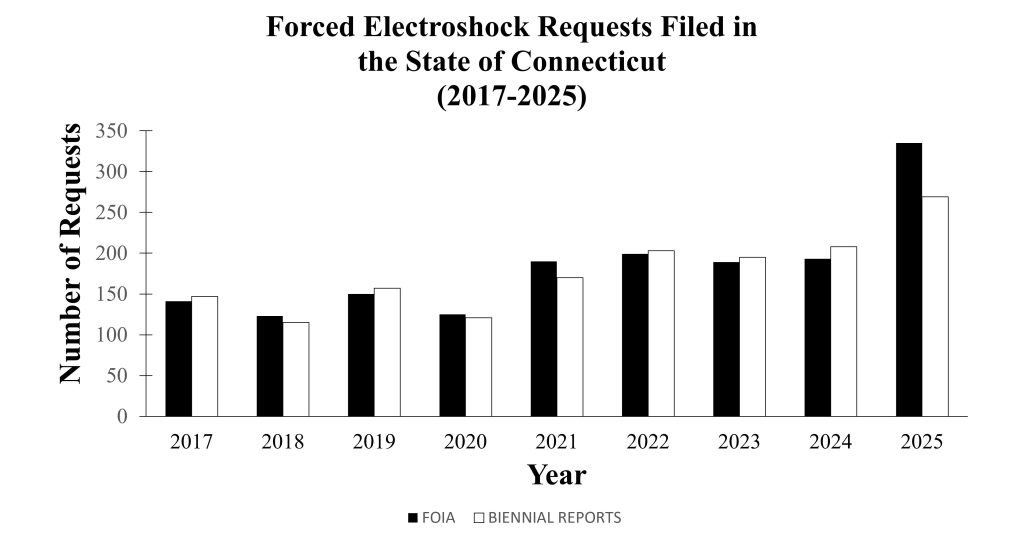
Requests for forced electroshock treatment filed in Connecticut as reported by the Office of the Probate Court Administrator’s Biennial Reports and via FOIA request (2017-2025)
Note that the Biennial Reports show that there was a 29% increase in forced electroshock requests in 2025 while the FOIA data reveals a 74% increase, which is explained by Biennial Report data being reported by fiscal year (ending June 30 of a given year, beginning July 1 of the previous year) and the FOIA data being provided by calendar year.
This concludes the mystery of how the data is to be interpreted and hopefully any obligation I feel to write about it.