
Last year, I wrote to the State of Connecticut Office of the Probate Court Administrator requesting data on forced electroshock requests filed throughout the state. They provided data going back to 2012, which not only included the totals for each calendar year, but also broke the data down by probate district as well.
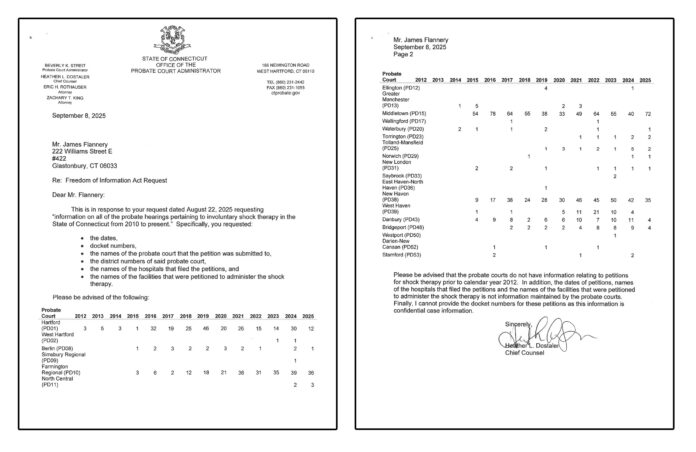
Letter received from the State of Connecticut Office of the Probate Court Administrator containing data on forced electroshock requests received by district probate courts.
Upon analysis, the data revealed an unsettling story: from 2012 and 2024 there was over a 6,333% increase.
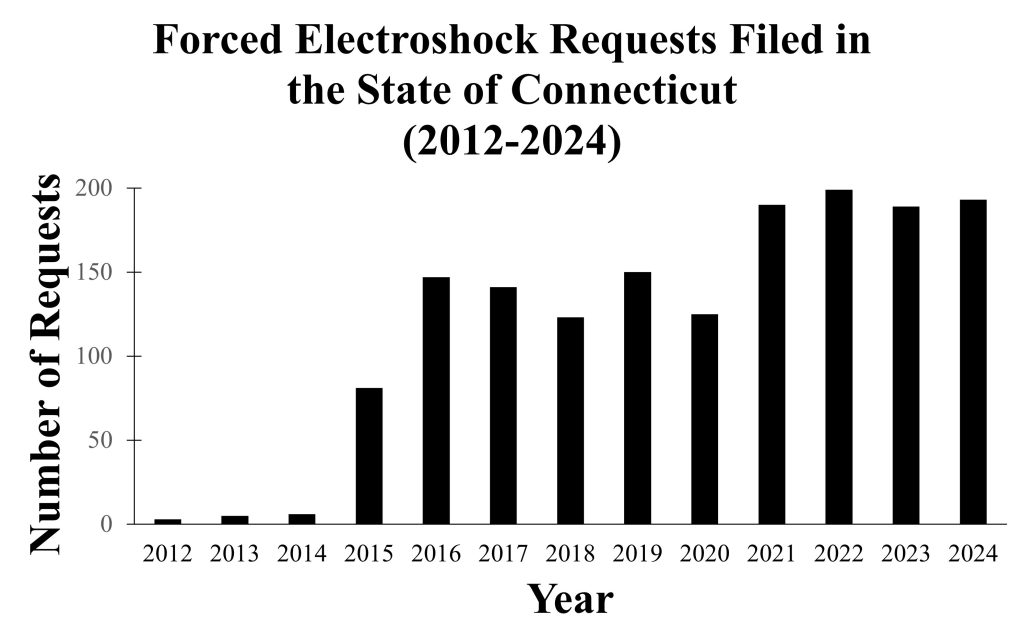
Requests for forced electroshock treatment filed in Connecticut as reported by the Office of the Probate Court Administrator’s via FOIA request (2012-2024)
Since then, a small number of journalists (thank you to Amy Wu, Marc Fitch, and I guess even Scientology’s astroturfed anti-psychiatry team over at CCHR) reported on the matter, compelling the state to respond to the alarming increase. Their answer: there was no increase.
As reported by Inside Investigator*, both the Deputy Medical Director for the Connecticut Department of Mental Health and Addiction Services, Dr. Vinneth Carvalho, and the Director of Interventional Psychiatry at UCONN Health Center, Dr. Caleb Battersby, attributed the perception of an increase to the COVID-19 pandemic:
- Battersby: “During COVID there was a disruption in ECT services… I wonder if that led to some decline and now, you’re seeing the numbers build up again.”
- Carvalho: “What happened was that COVID happened. So, the numbers dipped during COVID.”
How can that be when the data clearly shows otherwise?
As it turns out, there is another set of data reporting forced electroshock requests in Connecticut, which can be found in the Probate Court Administrator’s Biennial Reports. This data set shows only about a 200% increase. (Note that there was no Biennial Report released for 2018-2019, thus there is no data for those years).
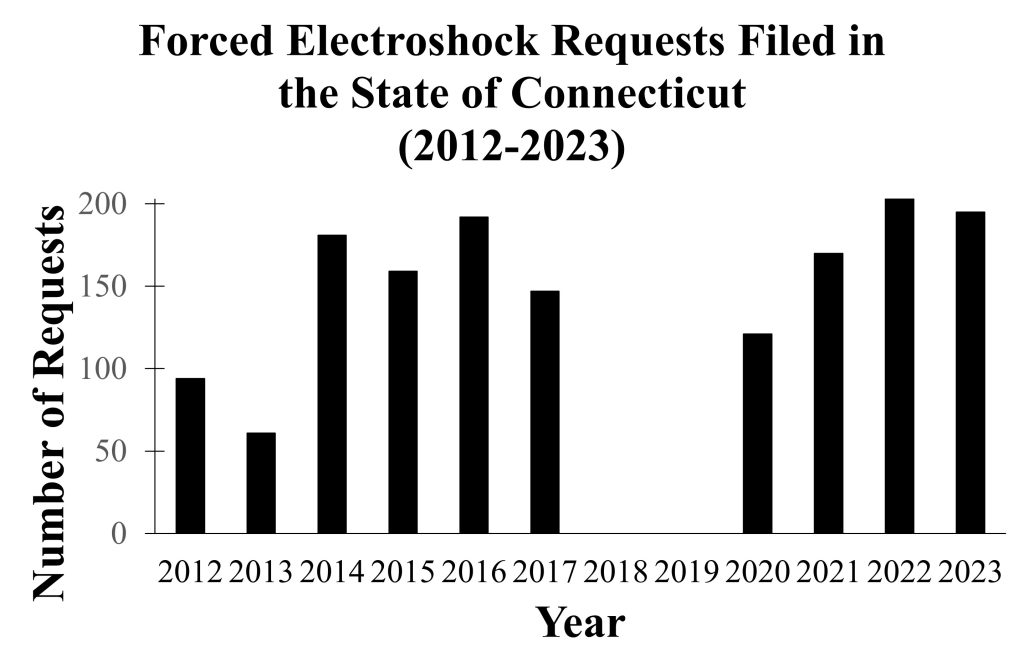
Requests for forced electroshock treatment filed in Connecticut as reported by the Office of the Probate Court Administrator’s Biennial Reports (2012-2023)
The question must be asked: which data set is accurate?
The people who provided the two data sets would have to answer that, and I’m more than sure they would like to clear this all up before they release their 2024-2025 Biennial Report. Feel free to contact them.
See Part 1: “Connecticut’s Forced Electroshock Problem” on MadinAmerica.
*Credit to Marc Finch for finagling two admissions from the Director of Interventional Psychiatry at UCONN Health regarding electroshock treatment:
(1) “There are side effects, and the cognitive side effects can be pretty significant depending on the person and the modality of ECT being used.”
(2) “We don’t necessarily know how it works. There’s lots of different explanations… The mystery of its effectiveness is not unique in psychiatry; a lot of medications, a lot of treatments we use, we have some idea why they work, but certainly not the full picture.”